Another Timbre TimHarrisonbre
Interview with Kyle Bruckmann & Ernst Karel (EKG), autumn 2008
Firstly why ‘EKG’? Does it stand for anything?
Kyle: The Ernst and Kyle Group. Honest. Obviously, there are a couple winks and resonances embedded therein as well, but they’re side effects. At the risk of tipping our hand: there’s the technological / biological conflation, the Germanic element that references both of our family backgrounds and so much of what’s been musically influential to the project…and Ernst may be mortified, but I’ll also admit to getting a kick out of the nod to the old-school hardcore band naming convention (GBH, DOA, DRI…)
Ernst: Kyle sells me short. My favorite band as a 14-yr-old in 1984 was MDC….
You have described EKG’s music as “between acoustic and electronic, improvised and premeditated, disruptive and meditative”. Why situate yourselves ‘between’? Is this important?
Kyle: Yes. Personally, I realize that one thread tying all my creative projects together is an obsession with that liminal state, the productive tension of both/and, neither/nor. I find a never-ending state of “becoming” a hell of a lot more interesting than any form of alleged certainty, and more honest. I think in EKG in particular there’s room for a very subtle, very delicate blurring of lines and interpenetrating of spheres…for instance, something as obvious as approaching our horns like electronics and our electronics like horns, exploring the timbral overlap and thinking about how sound behaves relative to its origin…
Ernst: It seems important for the music that it be between all kinds of things. For example, there was a tour where halfway through, we realized that we had been working on a composition the whole time rather than improvising. This process continues as we make our albums, where the imaginary line between improvisation and composition is further erased.
To my ears ‘Electricals’ seems the most composed of your discs so far. Were the pieces on the album studio-created, or do they have their origins in live performances?
Kyle: Yes and yes. We’re not improv purists by any means; all of our albums are painstakingly edited from a combination of live performances, direct-to-hard-drive rehearsals, and sometimes solo elements added after the fact. The process of playing is improvisational; our intent when assembling an album is definitely compositional. I guess the only real procedural difference this time around is that I finally got my hands on some editing software and started pulling my share of the weight – previously pretty much all of that stage of the work had fallen on Ernst.
Ernst: Yes, in terms of process, it’s not any more ‘composed’ than our other albums, but I think we’ll take that as a compliment nonetheless! As Kyle said, they’ve all involved a lot of editing and mixing, and the difference with this one is that Kyle did the editing.
You hardly play trumpet on ‘Electricals’ at all, Ernst. Are you moving away from using the trumpet as a sound source?
Ernst: At least for now, yes….
You always describe your electronic instrumentation as ‘analog electronics’. Why do you not use digital technology at this stage of your music? Why does it matter that you’re using analogue equipment? Does it sound different or affect the way you play?
Ernst: A couple of things. First, I’ve been heavily influenced by music from the electronic music studios of the 1950s and 1960s; I love the sounds that those machines were capable of, and essentially the technology we’re using is similar. Second, the analog modular equipment we use forces a way of interacting with the sound, both with the interface of the instrument and with the very electricity itself, that’s quite different from using a computer or other digital device. For example I'll often leave cables hanging from the various inputs and outputs of the modular analog system and make or break connections by touching cable-ends together or to the metal table or to my fingers, changing the strength of the signal by how much skin is conducting it, and in this way rerouting signals back into the system. This allows for a kind of playing that’s a little bit similar to the kind of moment-to-moment dependence of the trumpet on the physical state of the body.
So what is your musical background? When did you start playing trumpet & when did you start composing music for tape or electronics?
Ernst: I began playing trumpet as a child, just because my father played trumpet – other instruments I took up but didn’t continue with were mandolin, piano, and electric guitar – and played mainly classical/composed music until college, where I studied music theory and performance (but ended up majoring in comparative religion), and jazz and improvised music and noise during and after college. I started working with electronics (pedals, amps, etc.) in my early 20s, as a way to extend the possibilities of the trumpet, and have been working with analog modular electronics seriously for about 10 years now.
Kyle, you seem to work across several genres of music, from classical through jazz & improv to avant rock. What is your musical background, and why this broad reach?
Kyle: I’m not sure how to answer that without my entire life story, but I’ll try to rein it in…My first instrument was actually the organ, from the time I was 6; I started the oboe when I was 9. Growing up, music was an all-encompassing pursuit, a real playground – I was involved in choirs, camps, youth orchestra. The records my parents played at home were all over the place: top 40 Classical, Spike Jones, Bavarian oompah; thanks to some influential music teachers, I was exposed to Ives, Stravinsky, Varese at impressionable stages. Adolescence hit; hormones and the local college radio station spurred me to construct my social identity around hardcore, new wave, and especially industrial. When I went off to college, all I knew was that I thought music was fun; I’d never given any realistic thought to what the heck it would mean to be a professional. But because I landed in the school where I did with an oboe in my hands, I was very quickly shunted down the path of an orchestral performer, a specialist, a cog within a creaking museum piece – the University as a whole was amazing, but the conservatory, though world-class at what they do, had a VERY narrow focus. I spent a lot of energy trying to convince myself that that’s what I really wanted, internalizing the attitude that all the other music I loved outside of the European Common Practice Period was illegitimate, a waste of time – it kind of screwed up my head for quite a while. But I stayed involved in the college radio station, kept reading and listening, and never outgrew the punk bands, despite my professors’ browbeating and my own self-flagellation. It was discovering improvisation just as I was transitioning to graduate school that really saved me – it allowed me to directly reengage with creativity, to integrate and connect the dots between my interests and my training, providing a framework to think about the wider world of music and how and why people use it.
Now, part of what I do have the conservatory to thank for is my discipline and training as a stylist. Even within a scope as narrow as 300 years of European art music, a hyperconsciousness to context is required: there are mindsets specific to playing German as opposed to Italian repertoire, 17th as opposed to 18th century, 2nd as opposed to principal oboe, etc. I suppose I’ve taken that orientation and run with it – perhaps too far, and in too many different directions, but it’s what gets me out of bed in the morning. Always wanting to explore ‘now, if the oboe were in a context of electroacoustics/free jazz/no wave/indie rock/whatever, would it work? And if so, how? What would be required?’ So at this point, I try to focus on different core projects that, while interrelated, address different creative and aesthetic needs, and I try to delve fully, with integrity, to the heart of what I see as specific to each.
You play oboe & English horn, both double-reed instruments, which is relatively rare in improv or jazz, certainly when compared to sax or clarinet. Why do you think double reeds are relatively rare in new music? And are there other double-reed players who have influenced you?
Kyle: Well, at least in the Darmstadt/compositional branch of new music, there’s plenty of oboe, thanks in large part to the legacy of Heinz Holliger, and descendants like Peter Veale. There’s Joseph Celli, who’s more a part of the lineage of the New York School, fluxus, conceptually-oriented sound art. My grad school teacher Harry Sargous really opened some doors for me; he commissioned and played a lot of composed new music and was starting to explore improvising and Max applications while I was there. And I’d have to mention my friends and colleagues Robbie Hunsinger, with whom I played a lot when I first moved to Chicago, and Carrie Shull, and bassoonists Sara Schoenbeck and Katy Young.
But it’s true: double reeds are relatively absent from the history of improvised music. In part this is simply because there are fewer of us around than single reed players, so statistically there are fewer to stray. Honestly, it’s a rather difficult instrument, and we’ve got plenty to worry about just being able to play “normal” music well. We seem to tend to be a rather tightly wound lot; apparently I was wound tightly enough that the spring sprung.
There are pretty clear reasons why the oboe doesn’t factor as much into the lineage of jazz, though. It’s not exactly the People’s Instrument – the damn thing’s too expensive, and the reeds are too finicky and fragile. It can’t play nearly as loud as a saxophone, and the articulation doesn’t lend itself readily to anything resembling swing. There are players who’ve made a credible case for it within relatively traditional contexts, like Yusef Lateef and Ken McIntyre, but it’s an uphill battle, and nothing I have any business attempting in public. In the realm of free jazz, there’s much more of a legacy of saxophonists picking up an oboe temporarily for suitably exotic and “aegyptian” color: Sonny Simmons’ English horn, for example, and of course Marshall Allen, who really blew my head open when I first encountered Sun Ra records.
I should also really mention how much even superficial listening to the oboe’s various cousins around the world (shenai, duduk, suona, piri) makes it glaringly apparent how pathetically domesticated and limited the Western classical oboe has become, and suggests alternate paths.
Have you ever been tempted to try other wind instruments?
Kyle: Yes, and I’ve never dared, because I fear I’d never look back; I’ve always had bass clarinet envy in particular.
The oboe produces a relatively thin sound compared to the saxophone, yet on the electronics side the sounds you work with seem to be substantially thicker and more textured than the thinner sounds favoured by, say, some of the Japanese electronics improvisers. Do you consciously aim for a balance of different textures in your music?
Kyle: I suppose I would say that we really think of ourselves as musicians first and foremost, not as sound artists or conceptualists…and I don’t think we’re out to overturn or negate anything. I think we’re really rather traditional in terms of what we do, yes, consciously aim for: balanced orchestration, counterpoint, dramatic contour, nuanced texture, phrasing…Ernst, is that fair?
Ernst: I might imagine the line between ‘music’ and that other stuff to be more imaginary. I don’t consciously aim for a balance of different textures per se, but I do want the music to grow out of itself.
Ernst, as well as music, you work a lot in ‘media anthropology’. Could you briefly explain what ‘media anthropology’ is, and does this perspective inform your musical work?
Ernst: This would be media anthropology in the sense of doing anthropology through media, such as video or (in my case) audio, rather than in the sense of studying the media of other cultures. I’ve been interested for a long time in the way our experience of the world is mediated through sound. In graduate school at the University of Chicago I did ethnographic research on the way that sound functions in various contexts in South India. One project had to do with the religious and phenomenological experience of the sound of bells during Hindu ritual, and my doctoral work was concerned with larger questions of the connections between sound and social identity, for example the way amplified sound is used to describe social spaces in an urban context. My interest in ‘sound’ has always informed my ‘music’, but recently perhaps in a more obvious way, compositionally, for example in a new project coming out on and/OAR called Heard Laboratories. This piece consists of edited compositions of unprocessed recordings made in research labs at Harvard University, where I work; I think of it as both straight documentary and ‘acoustic electronic’ music. While I’m in Basel, Switzerland, this fall, I’m working on a couple of other projects which are ethnographically motivated and similarly situated between the documentary and the abstract. One has to do with the sounds surrounding the studio where I'm working on the Rhine river, almost right at the point where France, Germany, and Switzerland meet; there is a major Swiss port on the Rhine, a train yard behind the building, and a trucking business in the building. This is a place where things come and go, and the sounds echo around in the open spaces here. The other project has to do with the various kinds of transportation that are specific to a mountainous environment, e.g. gondolas, chairlifts, funiculars.
Last year EKG performed a version of Morton Feldman’s composition ‘Oboe and Orchestra’, with Ernst recreating the orchestra parts through electronics. Why did you do this & how did it go? Is there a growing classical influence in EKG’s work?
Ernst: Well, in terms of the influence of composed music on our work, it’s always been there, whether in terms of the ‘classical’ electronic music studios or in terms of 20th century composers like Nono, Scelsi, Gubaidulina, or Saariaho. But the Feldman piece is part of our newest project, still in process, which will be an album of pieces composed by other people and performed by us. We both love Feldman’s music, and we’ve in fact stolen harmonies from him in the past (for Group). It occurred to me to do ‘Oboe and Orchestra’ one day as I was marvelling at the textures created by his harmonies. At first I thought I would be approximating those textures more intuitively using electronics, but the more I studied the piece I realized that they really depend upon or emerge from the specific pitch relationships. So I ended recreating the score note-for-note, creating a sonority to represent each instrument and hand-tuning my oscillators for each pitch (no keyboard was used!).
How would you characterise the improv scene in the States in comparison with Europe at the moment?
Kyle: I’m afraid I’ve only toured in Europe once, so I can only guess from afar. And I don’t get out nearly as much lately even within the States – our daughter was born in Feb. ’08, so my priorities have definitely shifted this past year. But what I think I’m seeing amongst our peers here – and this may very well be projection – is a restlessness with any sort of dogmatism, any doctrinaire approach, just as it’s become a given (at least amongst critics) that there’s a line in the sand between “eai” and good old fashioned free improv, or even, god forbid, free jazz or Creative Music. I must say, I think some of what you’ve done with Another Timbre has done a good job of muddying the waters productively, drawing connections between generations and “camps,” providing some historical perspective (I’ve always been uncomfortable with the conception of eai as a genre at all, much less one that was allegedly invented in Tokyo/Berlin/Vienna in the late 90s). So maybe it’s really just as true amongst artists in London or elsewhere in Europe, but here and now there seems to be absolutely no inconsistency with making music one night that’s so “lowercase” it’s almost a caricature, blasting all-out noise the next, collaborating with scum kids and freak folkers… In part, I think it’s because there’s a sense that nothing’s at stake, so there’s no real compulsion to rigidly define yourself; I know of only a very small handful of American peers who can be said to be in any way making a full-time “career” of experimental music.
From what I can see from across the ocean there are a lot of little new music scenes in the States but they are thinly spread, just because the country is so vast. And you two live on opposite coasts, thousands of miles apart. This must make collaboration difficult?
Kyle: We don’t work together nearly as often as we’d like, but we laid a pretty significant foundation together in Chicago between around ’98 and ’03, and our process has adapted nicely to handicaps of time and distance. As for the US as a whole, I think there’s actually a surprising amount of interaction among scenes given the country’s vast size. I like to cite our friends nmperign in particular (though obviously there’ve been lots of folks involved) for really applying the venerable Black Flag model of DIY, get-in-the-van, do-or-die, windmill-jousting touring to the younger generation of the improv world in the late 90s. It’s getting harder, though, with the price of gas here finally creeping closer to its devastating true cost.
What else can we look forward to from you in 2009?
Kyle: 2009 should see the backlog of work I piled up in the past few years (before I so gloriously upended my life by becoming a dad) finally coming to light. I’ve got a collaboration with our old friend Olivia Block (some of our seminal proto-EKG work together was playing as part of her horn section) due for release on either/OAR. Pink Mountain, an over the top prog/skronk/psych band with Sam Coomes, Scott Rosenberg and Gino Robair, will have a double LP (!) out on Sickroom around April and hopefully a European tour in October.
I suppose a slightly new trend in my work is another result of finally having editing software, albeit a much campier and more ham-fisted result than anything you’ll hear in the context of EKG. There’s Cube of Force, a feisty pseudo-techno/electroacoustic/ noise amalgam for which I’m still trying to find a home. Out shortly on the new label Wodger is Bleaks, a very bizarre one-off with my friends Steve Silverstein (Christmas Decorations) and Jeremy Lemos (White/Light, Sonic Youth soundman) that to my ears recalls doom metal and the droll minimalism of Dome and This Heat more than anything else...
Otherwise, there should hopefully be more work with Wrack before too long, and things on the home front are really ramping up with sfSound ( HYPERLINK "http://www.sfsound.org/" www.sfsound.org). It’s going to be incredibly interesting going forward, as I try to figure out how to balance creative with family life and the unfortunate need to prioritize gigs that actually pay.
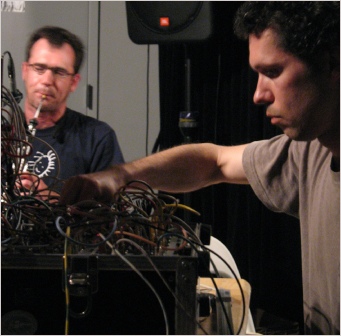
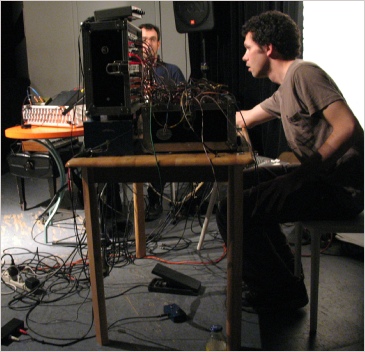
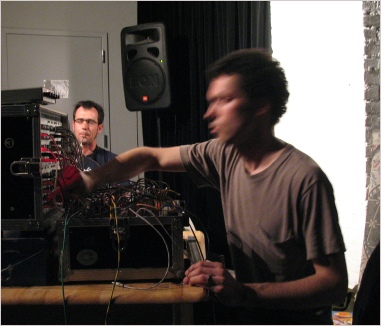
Kyle Bruckmann (left) & Ernst Karel (right) in performance